TEKS (Texas Essential Knowledge and Skills)
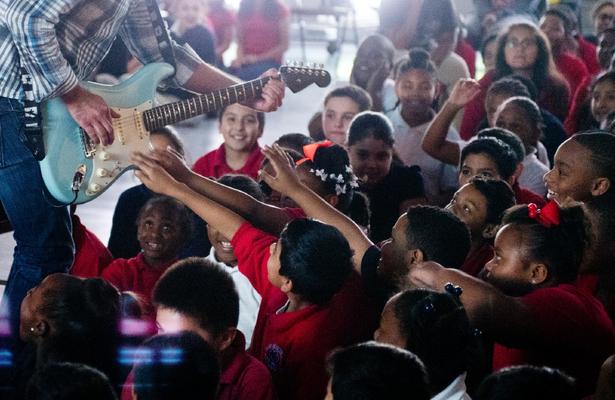
The Mr. Blue Shoes Program meets the following Social Studies, Music and Theater requirements for the Texas Essential Knowledge Skills (TEKS).
📘 §113.16. SOCIAL STUDIES
(c) Knowledge and skills.
🇺🇸 (4) History. The student understands political, economic, and social changes that occurred in the United States during the 19th century. The student is expected to:
(C) identify significant events and concepts associated with U.S. territorial expansion, including the Louisiana Purchase, the expedition of Lewis and Clark, and Manifest Destiny;
(D) explain the central role of the expansion of slavery in causing sectionalism, disagreement over states' rights, and the Civil War;
(E) explain the effects of the Civil War, including Reconstruction and the 13th, 14th, and 15th amendments to the U.S. Constitution; and
(F) identify the challenges, opportunities, and contributions of people from various American Indian and immigrant groups such as the settlement of the frontier and building of the Transcontinental Railroad.
⏳ (5) History. The student understands important issues, events, and individuals in the United States during the 20th and 21st centuries. The student is expected to:
(A) explain the significance of issues and events of the 20th century such as industrialization, urbanization, the Great Depression, the world wars, the civil rights movement, and military actions;
(C) identify the accomplishments and contributions of individuals and groups such as Susan B. Anthony, Martin Luther King Jr., Rosa Parks, Cesar Chavez, Franklin D. Roosevelt, Ronald Reagan, the Tuskegee Airmen, and the 442nd Regimental Combat Team in the areas of civil rights, women's rights, military actions, and politics.
🗺️ (6) Geography. The student understands places and regions in the United States. The student is expected to:
(A) describe political and economic regions in the United States that result from patterns of human activity;
(B) describe regions in the United States based on physical characteristics such as landform, climate, and vegetation;
(C) locate on a map important political features such as the five largest cities by population in the United States and the 50 states; and
(D) create a map of important physical features such as the Appalachian Mountains, Great Lakes, Mississippi River, Great Plains, and Rocky Mountains.
🏡 (7) Geography. The student understands the location and patterns of settlement and the geographic factors that influence where people live. The student is expected to:
(A) identify and describe the patterns of settlement such as rural, urban, and suburban;
(B) explain the geographic factors that influence patterns of settlement and the distribution of population in the United States; and
🌍 (8) Geography. The student understands how people adapt to and modify their environment. The student is expected to:
(A) describe how and why people have adapted to and modified their environment in the United States such as the use of human resources to meet basic needs; and
(B) analyze the positive and negative consequences of human modification of the environment in the United States.
💼 (12) Economics. The student understands patterns of work and economic activities in the United States. The student is expected to:
(A) compare how people in different regions of the United States earn a living, past and present;
(B) identify and explain how geographic factors have influenced the location of economic activities in the United States;
(C) analyze the effects of immigration and migration on the economic development and growth of the United States; and
(D) describe the impact of mass production, specialization, and division of labor on the economic growth of the United States.
🗽 (16) Citizenship. The student understands important symbols, customs, celebrations, and landmarks that represent American beliefs and principles that contribute to our national identity. The student is expected to:
(B) sing or recite "The Star-Spangled Banner" and explain its history;
🎨 (20) Culture. The student understands the relationship between the arts and the times during which they were created. The student is expected to:
(A) identify significant examples of art, music, and literature from various periods in U.S. history such as the painting American Progress, "Yankee Doodle," and "Paul Revere's Ride"; and
(B) explain how examples of art, music, and literature reflect the times during which they were created.
🤝 (21) Culture. The student understands the contributions of people of various racial, ethnic, and religious groups to the United States culture. The student is expected to:
(A) describe customs and traditions of various racial, ethnic, and religious groups in the United States; and
(B) summarize the contributions of people of various racial, ethnic, and religious groups to our national identity.
🚂 (22) Science, technology, and society. The student understands the impact of science and technology on society in the United States. The student is expected to:
(B) identify how scientific discoveries, technological innovations, and the rapid growth of technology industries have advanced the economic development of the United States, including the transcontinental railroad and the space program;
🧠 (23) Social studies skills. The student applies critical-thinking skills to organize and use information acquired from a variety of valid sources, including technology. The student is expected to:
(A) differentiate between, locate, and use valid primary and secondary sources such as technology; interviews; biographies; oral, print, and visual material; documents; and artifacts to acquire information about the United States;
(C) analyze information by applying absolute and relative chronology through sequencing, categorizing, identifying cause-and-effect relationships, comparing, contrasting, finding the main idea, summarizing, making generalizations and predictions, and drawing inferences and conclusions;
(E) identify different points of view about an issue, topic, historical event, or current event; and
(F) identify the historical context of an event.
🗣️ (25) Social studies skills. The student communicates in written, oral, and visual forms. The student is expected to:
(A) use social studies terminology correctly;
(B) incorporate main and supporting ideas in verbal and written communication;
(C) express ideas orally based on research and experiences;
🎸 §117.118. MUSIC, GRADE 5, ADOPTED 2013
(b) Knowledge and skills.
👂 (1) Foundations: music literacy. The student describes and analyzes musical sound. The student is expected to:
(A) distinguish among a variety of musical timbres, including those of children's voices and soprano, alto, tenor, and bass adult voices;
(B) distinguish among a variety of musical timbres, including those of woodwind, brass, string, percussion, keyboard, electronic instruments, and instruments of various cultures;
(C) use known music symbols and terminology referring to rhythm; melody; timbre; form; tempo, including accelerando and ritardando; dynamics; articulation; and meter, including simple and compound, to explain musical sounds presented aurally; and
(D) identify and label small and large musical forms such as abac, AB, and ABA; rondo; and theme and variations presented aurally in simple songs and larger works.
🎤 (3) Creative expression. The student performs a varied repertoire of developmentally appropriate music in informal or formal settings. The student is expected to:
(A) sing and play classroom instruments independently or in groups with accurate intonation and rhythm;
(B) sing or play a varied repertoire of music such as American folk songs, patriotic music, and folk songs representative of local and world cultures independently or in groups;
(C) move alone and with others to a varied repertoire of music using gross motor, fine motor, locomotor, and non-locomotor skills and integrated movement such as hands and feet moving together;
🤠 (5) Historical and cultural relevance. The student examines music in relation to history and cultures. The student is expected to:
(A) perform a varied repertoire of songs, movement, and musical games representative of diverse cultures such as historical folk songs of Texas and America and European and African cultures in America;
(B) perform music representative of Texas and America, including "The Star Spangled Banner";
(C) identify and describe music from diverse genres, styles, periods, and cultures; and
(D) examine the relationships between music and interdisciplinary concepts.
👏 (6) Critical evaluation and response. The student listens to, responds to, and evaluates music and musical performances. The student is expected to:
(A) exhibit audience etiquette during live and recorded performances;
(C) describe specific musical events such as changes in timbre, form, tempo, dynamics, or articulation in aural examples using appropriate vocabulary;
(D) respond verbally and through movement to short musical examples;
(E) evaluate a variety of compositions and formal or informal musical performances using specific criteria; and
(F) justify personal preferences for specific music works and styles using music vocabulary.
🎭 §117.119. THEATRE, GRADE 5, ADOPTED 2013
(b) Knowledge and skills.
💭 (1) Foundations: inquiry and understanding. The student develops concepts about self, human relationships, and the environment using elements of drama and conventions of theatre. The student is expected to:
(C) respond to sounds, music, images, language, and literature using movement;
(D) express emotions and relate ideas using interpretive and planned movement and dialogue;
🎬 (2) Creative expression: performance. The student interprets characters using the voice and body expressively and creates dramatizations. The student is expected to:
(A) demonstrate safe use of the voice and body;
📜 (4) Historical and cultural relevance. The student relates theatre to history, society, and culture. The student is expected to:
(A) explain theatre as a reflection of life in particular times, places, cultures, and oral traditions specific to American history;
(C) analyze and compare theatre artists and their contributions to theatre and society.
🎟️ (5) Critical evaluation and response. The student responds to and evaluates theatre and theatrical performances. The student is expected to:
(A) analyze and apply appropriate audience behavior at a variety of performances;
(B) compare visual, aural, oral, and kinetic aspects of informal and formal theatre with the elements of art, dance, or music; and
(C) identify and discuss how movement, music, or visual elements enhance ideas and emotions depicted in theatre.